


Trifecta in Tribulation – (MANGER Part 4)

Making A Nation Great and Eternally Revered, Part 4 of 4

Nature’s Fireworks on July 4th, 2026. Aurora Borealis over Lake Yellowstone

In the last post, Mother of Exiles, (part 3 in the Making A Nation Great and Eternally Revered series), we looked in depth at the criteria that God used to define greatness in a nation and how God implores His people to identify with aliens having themselves been in places of misery and exile before. 

Emma Lazarus’ famous poem, The New Colossus, inscribed at the base of America’s Statue of Liberty identifies Lady Liberty as the Mother of Exiles, standing at the welcoming “golden gate” of America’s premier port city eager to take in the world’s refugees. One wonders when America will return to its former glory and take on the mantle of Eternal Greatness by once again embracing aliens and welcoming the world’s poor, destitute, tempest-tossed, refuse…  refugees… as championed in Lazarus’ poem. 

In a world that celebrates  power through conquest in masculine terms, liberty is identified as a virtuous woman. Is it because women tend to be more hospitable and compassionate, with significant portions of their lives devoted to nurturing others? Could it be that liberty cannot be coerced merely by force, but must be nurtured and generously applied to those who are too weak to secure it for themselves? 

The Bible elevates one such character and devotes an entire book to the story of an individual who encompasses the trifecta of all three of God’s protected classes people: widows, orphans, and aliens. Ruth (which in Hebrew means “neighbor/companion/friend”) was the foreign born (Moabite) daughter-in-law of Naomi (“pleasant”) a Jewish woman from the tribe of Ephraim. A foreign woman would not be expected to be featured in the Jewish holy scriptures, let alone have an entire book devoted to her story as the main protagonist. And yet, in a patriarchal and religiously “pure” society, Ruth becomes the ONLY foreigner to have an entire book in the Holy Scriptures named and written about them, and earns a place in the genealogy of King David, and subsequently to Jesus.

Ruth’s story and that of her mother-in-law, Naomi, is one steeped deeply in tragedy.   Even though Naomi and her husband Elimelech (“my God is king”) are from the tribe of Ephraim, which means “fruitful,” their lives are anything but. They are forced because of famine to give up their ancestral lands in Judea and become exiles (aliens – ger) ending up in Moab (a region whose name finds its roots in patriarchal incest – definitely not a place of honor). Perhaps that is why they named their two sons, Mahlon (“diseased”), and Kilion (“wasting away”) as they find themselves settling in a foreign land away from their home, relatives, and religious community.

If being an alien ekeing out survival in a foreign land in the middle of famine were not bad enough, Naomi loses her primary source of providence, wealth, and protection when her husband Elimelech dies, leaving her to raise her sons on her own. With the death of Elimelech (“my God is my King”) one would forgive Naomi if she were to wonder if God (YHWH) was still her King. 

Much to the chagrin of an upstanding respectable Jewish household, Naomi’s two sons end up marrying outside of their religious faith, taking on foreign moabite wives (Ruth and Orpah) who know nothing of Judaism. To add insult to injury, her two foreign daughters-in-law are barren after 10 years and then, yet a deeper layer of affliction overwhelms her. Both of her sons die, depriving Naomi of her nuclear family, safety net, descendants, and the chance to continue the family line. 

Naomi’s story is one of unspeakable tragedy, and she hints to its agony when she tells her friends to call her Mara (“bitter”), “because the Almighty has made my life very bitter.”  The formerly pleasant has turned into bitterness.  Naomi might even be considered a female archetype of Job, who had an unending string miseries visited upon him. Where was God in the midst of those long strings of tragedy?

Let us now turn our attention to Ruth, who herself is no stranger to adversity. 

Ruth leaves her family and moabite community to marry into a jewish family to a man whose name means “diseased” (Mahlon – is that related to his infertility?). Her community’s heritage (at least from the Jewish point of view) is based on the dishonor of patriarchal incest (when Lot’s daughters ended up sleeping with their drunken father in order to produce children after the destruction of Sodom and Gomorrah). When she joins Mahlon’s family, she joins a family without a patriarch, for Elimelech has died. This makes Ruth fatherless – for she has left her own biological father and mother and joined another family whose father had passed away. She does not receive the protection and the financial security that the family patriarch would normally provide. When her own husband dies she is not only a widow, she is a functional orphan. This is made even more clear when she leaves Moab and follows her mother-in-law Naomi back to Bethlehem in Judea. In that moment, she becomes an exile from her own moabite community and pre-marital family. When Ruth chooses to stay with Naomi as Naomi returns to Bethlehem and Judea, she does so as a widow, orphan and alien. She is the trifecta of protected classes that are close to God’s heart. 

Ruth’s adversity is compounded by their infertility, and in a time and culture that prized offspring above almost anything else, 10 years of bareness leaves her without children to care for and without children to look after her when she herself grows old. She has no legacy to leave to the world and no “social security blanket” to guarantee her own future. And the shame of having no offspring is one that anyone can see – from Moab to Bethlehem.

Noami sees this and recognizes that Ruth’s and Orpah’s only hope to raise a family of their own would be to go back to their pre-marital moabite community and find a new husband and start over again. Naomi releases them from their familial obligations to her and implores them to go back to Moab to their mother’s house. (Does that imply that their fathers are not in the picture and perhaps have died, confirming their status as fatherless orphans? Common practice would be to return to their father’s house under a patriarchal society where he could provide protection, resources, and security, but curiously, that is not indicated here.)

Orpah, in alignment to the meaning of her name (“gazelle”) leaps at the chance, kisses Naomi goodbye, and heads back to Moab. Ruth, on the other hand is true to the meaning of her name (“friend/companion”) and clings to Naomi. Incidentally, the same word for “cling” used to describe Ruth’s committed attachment to Naomi is used to describe the cleaving of newlyweds in marriage earlier in Genesis. 

The next interaction becomes the reason for Ruth’s elevation to hero status. Ruth becomes the answer to Naomi’s redefinition of herself as afflicted by the Lord and returning home to Bethlehem empty. 

Naomi:  “go back to your mother’s home… May the Lord grant that each of you will find rest in the home of another husband”

Naomi: “It is more bitter for me than you, because the Lord’s hand has gone out against me!”

Ruth: “Where you go I will go, where you stay I will stay. Your people will be my people and your God my God. Where you die I will die and there I will be buried. May the Lord deal with me, be it ever so severely, if anything but death separates you and me..”

Naomi: “Call me Mara (bitter), because the Almighty has made my life very bitter. I went away full, but the Lord has brought me back empty. Why call me Naomi (pleasant)? The Lord has afflicted me; the Almighty has brought misfortune to me.”

This hearkens back to another key confrontation earlier in the scriptures, where God  (YHWH ) introduces himself to Moses, an orphan and alien in Egypt being asked to follow YHWH and lead his people out of enslavement.

Moses: “Lord, you have been telling me, ‘Lead these people’, but you have not let me know whom you will send with me…” (Ex 33:12)

God: “My presence will go with you and I will give you rest” (Ex 33:14)

Moses: “If your presence does not go with us, do not send us up from here.”

God: “I will do the very thing you have asked because I am pleased with you and know you by name”

Moses: “Show me your glory” [What is YOUR name, and what is your most famous/important quality?]

God: [I am] “YHWH, YHWH, the compassionate  and gracious God, slow to anger, abounding in love and faithfulness, maintaining love to thousands, and forgiving wickedness and sin.” (Ex 34:6-7)

Where Naomi feels afflicted by God and  abandoned by his goodness, Moses asks God for someone to go WITH him on this new mission of leadership. Naomi feels that she is returning to Bethlehem empty, totally bereft.

God tells Moses that He Himself will go with Moses, that his presence is the guarantor of success, and not only that, God’s presence will give Moses rest. 

Naomi tells Ruth to find rest in another husband. She has given up on finding another husband (and therefore rest) for herself. 

But Ruth rejects Naomi’s urgings, and pledges herself to be WITH Naomi, forever until death. Just like YHWH promised to be with Moses. 

Ruth, the widow, orphan, and alien, in making a similar pledge to be there for Naomi that YHWH makes to Moses, ensures that Naomi is not abandoned nor alone. Ultimately, as the story unfolds and Ruth eventually marries Boaz and becomes the great grandmother to King David. It is the restoration of this family line that would allow Naomi to experience rest through Ruth’s commitment to her. Because of Ruth, Naomi has a companion in suffering and is rescued from emptiness. Ruth is Naomi’s guarantee that God has not abandoned her and left her to wallow in suffering all alone.

Why is it that a foreign woman would merit the honor to be enshrined in holiest scriptures with their very own book? Could it be that this foreign woman exhibited the very qualities that demonstrate God’s glory?

A clue to this proposal can be found in the way YHWH describes him/herself to Moses. After God says to Moses that s/he knows Moses by name, Moses asks God to show him God’s glory – which is another way of saying, What is YOUR name?, and What is your most defining characteristic? 

God says to Moses, [I am] “YHWH, the compassionate (rachum) and gracious (chanun) God,….”

The first descriptor that God provides of him/herself in the entire Bible is that given to Moses after Moses asks God to reveal to Moses God’s glory. God could have chosen any number of impressive achievements to describe their glory (creator of all, most powerful of all, able to protect from harm or evil, etc.) but s/he chooses Compassion instead. To Suffer With (comp = with, passion = suffering). God wants to be famous for being the Suffering-With God. Compassion is YHWH’s glory, God’s first and most important characteristic. 

YHWH does not shy away from suffering themselves, s/he does not distance themself from suffering, nor shield themself from the pain, agony, and trauma, but s/he enters into it in order to be there WITH God’s people so that humanity is never totally abandoned nor alone.  

Ruth is the heroine in this story because she has taken on the most primary characteristic of YHWH – that of compassion – to a soul who has experienced immeasurable suffering akin to the levels of suffering encountered by Job. Perhaps one might read that YHWH enter’s Naomi’s story through Ruth, and that Ruth is the Angel of the Lord’s Presence to Naomi. Naomi did not return to Bethlehem empty and abandoned, she had a companion and friend, a Ruth, who was an emissary of YHWH’s providence and presence. 

Ruth could understand Naomi’s suffering because Ruth experienced exile, fatherlessness, death of a spouse, and infertility herself. Her own trauma qualified her to be a balm to her mother-in-law who was traumatized even more. Instead of abandoning Naomi to pursue her own rest (in finding another husband from her Moabite kin) Ruth chooses to remain an exile by following Naomi back to Judah and enters into a community of suffering with Naomi, pledging to suffer alongside with her until death. 

In Hebrew, the word for compassion is rachum, which has its root in “womb”. This is definitely a term with feminine roots, as the care a mother has for her children comes from a deep willingness to suffer with and for her children. 

Why is it that God has special favor for the three protected classes of widows, orphans, and aliens? Could it be that they are the ones who are most vulnerable to being alone and abandoned, with no friends, community, or social support? 

If God’s glory is to be compassionate, to suffer with, what does it mean for his people to reflect God’s glory to the world and thereby be a blessing to the world? 

Isn’t it curious that God chooses to use a foreigner, an Alien, and Widow, and Orphan, in Ruth, to demonstrate God’s glory in the book of Ruth? She is the only foreigner in the royal lineage that leads to King David, and ultimately to Jesus. But it is arguable that she more than any other person in that lineage, demonstrates the glory of God through compassion as revealed to Moses. 

What does it mean to Make A Nation Great and Eternally Revered? Could it be as simple as the nation welcoming, celebrating, embracing, and nurturing the widows, orphans, and aliens found within it… no matter how they got there or came to be? 

Ruth, a moabitess, showed the way to the nation of Israel, and her grafting into the patriarchal lineage of Jewish royalty stands as a jarring reminder that God’s most important characteristics have distinctively feminine and possibly foreign roots as evidenced by compassion.

Perhaps, we might go one step farther and give Lady Liberty, the Mother of Exiles, the name Ruth to remind us of YHWH’s compassion toward us and our imperative to extend that same compassion to all of the tired, the poor, the huddled masses, wretched refuse, homeless, tempest tossed around us and yearning to join our community. 

The question is not, “who is my neighbor or alien”, the REAL question to ask is, are we willing to be like Ruth?


Shall we call her Ruth?

Fountain of Liberty

Old Faithful geyser, Yellowstone National Park at sunset on July 4, 2026

On July 4th, 2026,  I christen thee, Fountain of Liberty… may your waters of freedom flow without bounds nor restrictions to all who need them… to the tired, the poor, the huddled masses yearning to breathe free, the refuse of other nations, the homeless, the aliens (ger). As you faithfully pour out your waters without ceasing every hour to 90 minutes reminding us that they are timeless and unending, may we be reminded to share that which has been meritlessly extended to us with all who desire to partake of your life giving qualities….

Video of Old Faithful erupting – https://bit.ly/July4LibertyFountain

Mother of Exiles – (MANGER Part 3)

Lady Liberty from below

In the first two posts of this series, we explored what it means for a nation to be great from an eternal perspective. We examined the template that God gave his most favored nation (Israel) on how to reflect his divine character by treating three specific classes of individuals (widows, orphans and aliens) with special care. God directly tied the wellbeing of the nation to its treatment of these protected classes, and warned against their mistreatment  upon threat of a violent curse from the almighty. Treating these protected classes well, and with special emphasis on aliens, means acting justly towards them, feeding them, clothing them, relating to them them as native-born, and loving them with affection as we would love ourselves. 

Jesus took this a step further when he described his task on judgement day, to divide peoples between the sheep and the goat. The sheep were those who took care of the protected classes (widows, orphans, aliens), and in doing so, took care of Jesus himself. Goats were those who neglected or mistreated the protected classes… and in doing so, neglected and mistreated Jesus himself. Jesus so identified with the protected classes that any service given to them was giving service to Jesus himself, and any neglect toward them was neglecting Jesus himself.

Why would the creator of the universe single out these three protected classes for special care and treatment? Why would God condition the welfare of these classes as the measure of greatness for a nation?

If we could come to understand why these protected classes are so near and dear to God’s heart, it might transform our approach to caring, advocating, and protecting them from a task to accomplish, to an outpouring of character that reflects God’s heart. 

There are multiple layers behind God’s imperative for his people to treat the widows, orphans, and strangers (aliens) among them with extra special care and attention. 

Recall that God mentions a reason why his own people should treat aliens and strangers (ger in the original Hebrew language) well: 

Exodus 22:21 Do not mistreat an alien (ger) or oppress him, for you were aliens (ger) in Egypt (mitzraim). 

Leviticus 19:34: “The alien (ger) living with you must be treated as one of your native-born. Love him as yourself, for you were aliens in Egypt (mitzraim). I am the LORD your God.

In these two examples, God draws the direct connection to God’s people having been aliens and strangers in their own history. 

Many of us are probably familiar with the Bible story of the Israelites being slaves in Egypt, and God raising Moses to lead them out slavery and toward a new homeland (Thanks to Disney’s The Prince of Egypt). The Jewish celebration of Passover (pesach) commemorates this salvation from bondage and release from misery. While in Egypt, the Israelites were aliens and strangers and subjugated under harsh treatment.

The Hebrew word that is translated in the Bible as Egypt is “mitzraim”, which itself is the plural form of the root mesar which means “trouble, distress, pain, and being in dire straits”. Some scholars link the Hebrew root mesar to the Arabic name for Egypt, misr. They are practically homonyms. One wonders then, if it is a coincidence, that the English word, misery, comes from the Latin word miseria, which comes from the root miser, which means “wretched” but also sounds quite close to the Egyptian misr, and the Hebrew mesar.

So the passages about aliens and how God’s people were once aliens in mitzraim  can be read from a specific historical event – of their forefathers having lived in exile in Egypt, but also as a generalization that the people of God have experienced misery themselves. They have been in dire straits before.

God is calling on his people to demonstrate empathy and compassion to the alien (ger) among them since they themselves know what it feels like to live in misery.  

There is another layer to this that goes deeper and farther back than the Israelites having been aliens themselves in Egypt and experiencing misery. 

The founding patriarch of the Jewish people, Abraham, was himself an alien. At a time when the Bible records humanity gravitating towards cities and assembling to build monuments to human achievement and technological advancement such as with the Tower of Babel, the Biblical narrative singles out one family who sets out from Ur, the regional center of culture in what is now southern Iraq leaving behind civilization and heading northwest toward the land of Canaan. 

Genesis 12:1 God to Abram:  Leave your country, your people, and your father’s household and go to the land I will show you.”

The very first thing we are told about Abram (who later gets renamed Abraham) is that he obeys God’s call to leave what is familiar and a source of security (his extended family and “home” culture) and willingly embarks on an adventure into the unknown.  Until God established a homeland for his descendants, Abraham and his offspring would be strangers and aliens wandering after the voice of God in various lands that were not their ancestral homes. Abraham himself would eventually spend some time in Egypt (mitzraim) as did his grandson, Jacob, who had a similar foray into Egypt as an alien. God also confirms to Abraham that his descendants would also be wanderers and strangers in a foreign land…. something that came true with his great-grand son Joseph and the generations after him.

Genesis 15:13 God to Abram: “Know for certain that your descendants will be strangers (ger) in a country not their own….”

The very birth of the nation of Israel through its founding forefather was accomplished through an act of obedience by Abram to become an alien/stranger (ger) by leaving his family and culture. Israel would not have come into being had not Abraham chosen the path of alienation from familiarity, safety, and predictability. 

As remarkable an origin story this represents, this was not the first time the Bible spoke about a main character leaving home and becoming an alien. 

That distinction goes to the story of Adam and Even who were themselves banished from the Garden of Eden. Eden was their original home, the place where they communed with God through daily walks. After their indiscretion with eating fruit from the Tree of the knowledge of good and evil (a symbol of their desire of independence and obtaining their treasure apart from God’s presence), Adam and Eve (and their descendants) were banished from the garden and forced to leave their “home” and become aliens living in exile for the rest of their lives. 

Exodus 3:23 So the LORD God banished him from the Garden of Eden to work the ground from which he had been taken. 24 After he drove the man out, he placed on the east side of the Garden of Eden cherubim and a flaming sword flashing back and forth to guard the way to the tree of life.

Not only is the nation of Israel and its founding patriarch intimately intertwined with feelings of alienation, but this theme runs back to the beginning of mankind itself. In the Biblical narrative, all of humanity became aliens after Adam and Eve’s expulsion from the Garden of Eden. Their choice of independence (in taking and eating from the Tree of Knowledge of Good and Evil apart from God’s presence) resulted in them losing their “home” of proximity with God and daily walks in the garden.

Indeed, this concept is reiterated in Psalm 119:

verse 19 “ I am a stranger (ger) on earth; do not hide your commands from me.”

The Psalmist is identifying themselves (or all of God’s people) as an alien/stranger (ger), the same word used in Exodus 22:21 and Leviticus 19:34 and translated as “alien” 

Exodus 22:21 can therefore be translated,

“Do not mistreat an alien/stranger or oppress him, for you yourselves were aliens/strangers in distress.

Leviticus 19:34 can also be translated,

“The stranger/alien living with you must be treated as one of your native-born. Love him/her as yourself, for you were stranger/alien in distress. I am the Lord your God.”

If God understands all of humanity as being estranged from him (cast out from the garden abode of Eden) and wishes for them to be cared for and nurtured even in their estrangement, this imperative for God’s people to treat the strangers/aliens among them well – with generosity and love – is a reflection of God’s compassion for those who have wandered from communion with him. God’s heart of compassion for the lonely, downtrodden, distressed flows not just for his own people, his own favored nation, but to all people and all nations including the aliens and strangers living among God’s people. When God calls his people to treat the alien/strangers among them well, he is compelling them to take on the same mantle that God wears for the poor, the afflicted, and the distressed. 

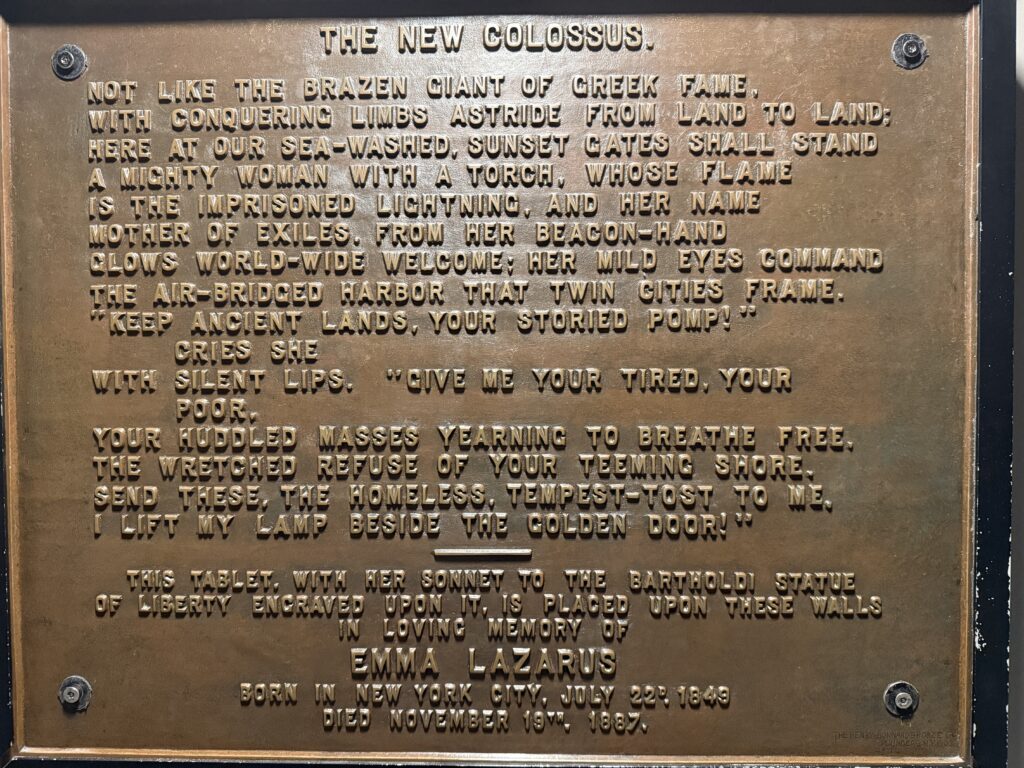
There is a plaque affixed to the base of the Statue of Liberty in New York harbor that reflects this very ethos. The poem inscribed on this plaque, The New Colossus, was written by Emma Lazarus, and captures the very essence of this attitude and value for the alien/stranger and a country’s eager willingness to embrace and welcome them to its shores. It contrasts Lady Liberty (Mother of Exiles) with the ancient world wonder monuments of old (Colossus) which glorified conquest through power. 

The New Colossus

Not like the brazen giant of Greek fame, with conquering limbs astride from land to land;

Here at our sea-washed, sunset gates shall stand, a mighty woman with a torch,

Whose flame is the imprisoned lightning, and her name Mother of Exiles.

From her beacon-hand glows world-wide welcome;  

Her mild eyes command the air-bridged harbor that twin cities frame.

“Keep, ancient lands, your storied pomp!” cries she with silent lips;

Give me your tired, your poor, your huddled masses yearning to breathe free,

The wretched refuse of your teeming shore – send these, the homeless, tempest-tost to me,

I lift my lamp beside the golden door!”

– Emma Lazarus (1848-1887)

. Plaque - New Colossus poem by Emma Lazarus

How well does this describe the country for which Lady Liberty stands as a gate? Can this country be considered the mother of exiles to the world’s poor, homeless, those yearning to breathe free? How does this country handle the “wretched refuse” who yearn to enter its gates? Will this country take on the heart of compassion that describes the God of the Bible? If a nation espouses to be a Christian nation, there is no option for how to proceed. The path has been elegantly shown in Emma Lazarus’s sonnet. Will the country live up to its ideals?

If this poem proved to be true and indicative of the country in which it stands as a gate for, it would be in perfect alignment with God’s heart for the alien and evidence that such a country would indeed be great in God’s eyes.

Statue of Liberty

“golden door”…. This is what it looks like to Make A Nation Great & Eternally Revered. (MANGER, part 3)

Being a GOAT – (MANGER part 2)

In the first post of this series, we explored the roots of God’s heart for three protected classes of people as described in the the Torah (the first five books of the Hebrew Scriptures which also form the first few books in the Christian Bible’s Old Testament). In this post, we will explore how this theme is addressed clearly and in no less uncertain terms in other parts of the Tanakh (Old Testament) as well as the Christian New Testament scriptures.

It is only a short step from being “Great Again” to wanting to be the Greatest Of All Time. There are no shortage of nations,  political parties, and individuals who wish to be recognized as the Greatest Of All Time (GOAT). Perhaps it is only human nature to want to be the greatest of all…. but perhaps we are endeavoring to being the wrong kind of domesticated animal.

Along the way, we are confronted by the question,  “what does it mean to be Great?” from an eternal perspective. 

In the Hebrew Scriptures, time and time again, God warns his people (the nation of Israel and its various tribes) that his judgement is coming and he charges his own most favored nation to treat the protected classes properly, ensuring they are treated justly, with generosity, and affection (love). This appears to be one of the clearest outward signs of a nation that is in alignment with God’s character and eternal values. This recurring message was echoed through the prophets. 

Before Israel’s sole remaining tribe of Judah was carried off into exile under Babylonian rule, God implored his people to forsake their waywardness, idolatry, and unjust treatment of the three protected classes through the prophet Jeremiah: 

“If you really change your ways and your actions and deal with each other justly, if you do not oppress the alien (immigrant), the fatherless or the widow and do not shed innocent blood in this place, and if you do not follow other gods to your own harm, then I will let you live in this place, in the land I gave your forefathers for ever and ever.  But look, you are trusting in deceptive words that are worthless.” (Jeremiah 7: 5-8)

Later on,

“This is what the LORD says: Do what is just and right. Rescue from the hand of his oppressor the one who has been robbed. Do no wrong or violence to the alien (immigrant), the fatherless or the widow, and do not shed innocent blood in this place.” (Jeremiah 22:3) 

God’s chosen people did not heed the warning and were carried off into captivity. Once in exile, the prophet Ezekiel picks up the refrain and explains the reason for their downfall: 

“‘See how each of the princes of Israel who are in you uses his power to shed blood.  In you they have treated father and mother with contempt; in you they have oppressed the alien and mistreated the fatherless and the widow.”  (Ezekiel 22:6-7)

After 70 years of captivity and exile to Babylon, the prophet Zechariah lays an option before the remnant of Israel : Will they be the type of people worthy to be part of a “New Jerusalem” that God is going to (re)build under a Messianic Kingdom? 

“And the word of the LORD came again to Zechariah:  “This is what the LORD Almighty says: ‘Administer true justice; show mercy and compassion to one another. Do not oppress the widow or the fatherless, the alien (immigrant) or the poor. In your hearts do not think evil of each other.’ “(Zechariah 7:8-10)

The entire book of Zechariah pivots on the existential question raised for the reader in chapter 7… will the reader follow the example of their forefathers who failed to uphold justice and protect the cause of the widow, orphan and immigrant? Or will they choose the path of God’s heart and priorities by administering true justice, showing mercy and compassion to one another, and caring for the three protected classes? 

Each one of these prophets had a similar message from the Lord almighty for the people who were God’s chosen and most favored. Caring for the protected classes was not simply a prescription for the time of Moses, it permeated the entire history of Israel as a recurring theme, and was one of the standards by which the entire nation would be judged.

The prophets pointed toward an anointed one who would bring salvation (yeshuah) and through whom God would usher in a new kingdom and restore his people from captivity and exile. 

The Christian New Testament scriptures identify this promised messiah as Jesus of Nazareth. (Jesus is the greek form of Yeshua, the Hebrew word for salvation). Jesus, brings this theme front and center in his last message to his closest followers (his disciples) a few days before his last meal (a Passover meal) which preceded his crucifixion, death, and resurrection as recorded in the Book of Matthew (chapter 25). The setting of this message is a future cosmic stage with angels and all nations looking on as Jesus, the Son of Mankind, sits on his throne administering the final judgment. He describes a separating process where he divides those who are allowed into his eternal kingdom (the sheep) and those who are turned away (the goats). 

Matthew 25:31-46   When the Son of Man comes in his glory, and all the angels with him, he will sit on his throne in heavenly glory.  All the nations will be gathered before him, and he will separate the people one from another as a shepherd separates the sheep from the goats.  He will put the sheep on his right and the goats on his left. 

Then the King will say to those on his right, ‘Come, you who are blessed by my Father; take your inheritance, the kingdom prepared for you since the creation of the world.  For I was hungry and you gave me something to eat, I was thirsty and you gave me something to drink, I was a stranger (greek: xenos) and you invited me in,  I needed clothes and you clothed me, I was sick and you looked after me, I was in prison and you came to visit me.’

Then the righteous will answer him, ‘Lord, when did we see you hungry and feed you, or thirsty and give you something to drink?  When did we see you a stranger and invite you in, or needing clothes and clothe you?  When did we see you sick or in prison and go to visit you?’

The King will reply, ‘I tell you the truth, whatever you did for one of the least of these brothers of mine, you did for me.’

“Then he will say to those on his left, ‘Depart from me, you who are cursed, into the eternal fire prepared for the devil and his angels.  For I was hungry and you gave me nothing to eat, I was thirsty and you gave me nothing to drink,  I was a stranger and you did not invite me in, I needed clothes and you did not clothe me, I was sick and in prison and you did not look after me.’

They also will answer, ‘Lord, when did we see you hungry or thirsty or a stranger or needing clothes or sick or in prison, and did not help you?’

He will reply, ‘I tell you the truth, whatever you did not do for one of the least of these, you did not do for me.

Then they will go away to eternal punishment, but the righteous to eternal life.”

In this story, it is much better to be a sheep than a goat. But what distinguishes the sheep from the goat is curiously similar to the warnings and charges that were found throughout the Hebrew Scriptures to take care of the protected classes. Jesus equates the treatment of those in need, the strangers (greek: xenos – the root from which we get the term xenophobia) – as tantamount to caring for Jesus himself. Feeding the hungry, giving drink to the thirsty, inviting the stranger (immigrant/alien) in, providing clothes, caring for the sick and imprisoned. Whoever is the LEAST of those around… to care for them is to care for Jesus, and to neglect them or to mistreat them is to mistreat Yeshua himself. 

Caring for the Least Among Us – That is what it means to be Great in the Kingdom of Heaven. 

So will those aspiring to be a GOAT end up being treated like the goats in Jesus’ story? Or should we rather be found to be like sheep and caring for the Least of those Among Us? Who are these “Least Among Us?” Might they be hiding in plain sight? Would we find them in a mansion or a manger? A restaurant or a food bank? A grocery store or a harvesting field?

Zechariah spelled out what it looks to be a goat and its consequences: 

“But they refused to pay attention; stubbornly they turned their backs and stopped up their ears. They made their hearts as hard as flint and would not listen to the law or to the words that the LORD Almighty had sent by his Spirit through the earlier prophets. So the LORD Almighty was very angry.

“‘When I called, they did not listen; so when they called, I would not listen,’ says the LORD Almighty.  ‘I scattered them with a whirlwind among all the nations, where they were strangers. The land was left so desolate behind them that no one could come or go. This is how they made the pleasant land desolate.’”  (Zechariah 7:11-14)

Those who wish to identify with the Kingdom of God, the Kingdom of Yeshua, should be easy to spot using formula Jesus gave for dividing sheep from goat. God’s economy is inverted compared to what the world values. Instead of through missiles and might, Greatness is to be found in service, love, and compassion. How do you define Great? Is it Eternally Relevant?

(Making A Nation Great & Eternally Revered – MANGER, part 2)

 In the next post of this series, we will explore clues as to why God has such a soft spot in his heart for these special protected classes of people (widows, orphans, and immigrants/aliens/strangers). 

Making A Nation Great & Eternally Revered (MANGER, Part 1)

What does it mean to Make A Nation Great?

With all the recent excitement about making certain nations great again (which is not a new concept, but one used in the 1930’s by Hitler in reference to Germany during the rise of Naziism, and more recently by Margaret Thatcher in 1950 with regards to Britain, and Ronald Reagan in his 1980’s American presidential election campaign), it may be instructive for those of a Judeo-Christian background to examine what the God of the Bible (which includes the Jewish holy scriptures Torah and Tanakh) had to say about building a nation.

Flag next to lake

When the God of the Torah (which forms the beginning of the Bible) set up a most favored nation, the nation of Israel, God gave them rules to live by, values to uphold, and explicitly described three specific classes of individuals who were to receive special treatment. The wellbeing of the nation was tied to the treatment of these protected classes, and the nation was cursed if it failed to adequately care for these protected classes. This is as close to a template for making a nation great as can be found in scripture and may provide a roadmap for today as nations consider what it means to be “great” and how to achieve or re-establish “greatness.”

The first place we are given a glimpse of this is in the passage from Exodus, the second book of the Torah:

“Do not mistreat an alien or oppress him, for you were aliens in Egypt. Do not take advantage of a widow or an orphan. If you do and they cry out to me, I will certainly hear their cry.  My anger will be aroused, and I will kill you with the sword; your wives will become widows and your children fatherless.” Exodus 22:21-24   

In this passage, we are introduced to three classes of individuals who are singled out for special care and consideration by God’s people: aliens, widows, and orphans (also known as the fatherless). It is remarkable that God takes care to warn that He is attentive to the plight of these protected classes and fiercely protective of them. He also warns that their mistreatment will incite His anger, and ensure a retribution by God against such mistreatment. God does not take mistreatment of these protected classes lightly, but rather has zero tolerance for such mistreatment in his favored nation, to the point of death and harm to one’s own kin.

The mention of these protected classes in God’s favored nation is not an isolated pronouncement in the book of Exodus, but a recurring theme that appears again and again in the Hebrew Scriptures… (see also Deuteronomy 10:18, 14:29, 16:11, 16:14, 24:17, 24:19, 26:12, 27:19; Jeremiah 2:3, 7:5, Ezekiel 22:7, Zechariah 7:8)

As we investigate further, we see that God exhibits a core value of kindness to these protected classes and takes an active role when they are mistreated: 

“For the LORD your God is God of gods and Lord of lords, the great God, mighty and awesome, who shows no partiality and accepts no bribes.  He defends the cause of the fatherless and the widow, and loves the alien, giving him food and clothing.  And you are to love those who are aliens, for you yourselves were aliens in Egypt.” Deuteronomy 10:17-19  

Here, the God of the Bible ties his majesty and magnificence and the foundation of his reputation to his oversight of the three protected classes and even focuses extra attention on aliens by tending to their need of food and clothing. “Alien” in Hebrew is “ger” – which can also be translated stranger or sojourner, and refers to people residing locally who are from a different region or nation. We learn that care and protection of these protected classes are a core part of God’s character.  We see a definition of what it means to be great in God’s economy. God juxtaposes “great”, “mighty”, and “awesome” with impartiality, honesty, and care for the protected classes. He did not equate greatness with military power, economic superiority, and judicial expediency.

In God’s economy, a great nation reflects God’s character and assumes the same priorities that God promotes and demonstrates. Anything less than protecting these special classes falls short. What are the measures being used by nations aspiring to be great again to quantify their greatness?

For those who identify as God’s favored nation, treatment of the aliens among them must be tempered by self reflection and the acknowledgement that they were once aliens themselves. Aliens are not a foreign “them.” This passage of scripture demands that the “chosen” of God’s people see aliens as “us”, or at least identifying with such as part of their own history. It erases the distinction between aliens and local born. 

How does a nation practice self reflection? How does a nation acknowledge it’s past and incorporate its own history of being isolated, weak, and in need of aid and assistance at some point in its past – as it considers how to treat the current “aliens” living among them? Can a nation have sufficient humility and fortitude to embark on such a self examination? Have countries done so successfully in the past?

If we wish to identify with being part of God’s chosen and favored nation, how do we evaluate our own personal history of neediness and alienation as individuals, as well as our families and our communities? Proper reflection is the prerequisite for appropriate action. 

Appropriate action is not passive, but stems from the direct imperative God gives his people to LOVE (Hebrew – ‘ahab) those who are aliens. The root of the word for love in Hebrew means to have affection for. It is not enough to refrain from harm (no mistreatment, no oppression, no taking advantage of…), but there is a prescriptive to treat them with affection. Instead of fearing aliens, God’s people are to extend love to them. What does it mean for a “favored” nation to love the aliens found within it? Is that happening in the nations who proclaim to want to be great again? 

We see a picture of a God who leads by example by giving the alien food and clothing. Is this God’s way of teaching us the first steps toward treating them with love and affection? (There is no distinction between “legal” and “illegal” alien in the Bible. If you are not from around here, you are an alien, regardless of how you got here…) 

There are other clues as to what it means to treat an alien properly in the scriptures:  

“Cursed is the man who withholds justice from the alien, the fatherless or the widow.”  (Deuteronomy 27:19)

Ensuring the aforementioned specially protected classes are treated with justice – in all of its forms – is an imperative. Failure to treat them justly, denying them due process and fair hearings, and treating them as one would want oneself treated in the same circumstance (which is at the core of evaluating justice) brings on the severe consequence of a curse from the Almighty. Nations who wish to be great in the eyes of God would be wise to heed this explicitly grave warning. In light of such a clear pronouncement, it goes without saying that nations certainly should not in any circumstance create orphans, or widows (by forcefully and unjustly separating married partners or children from their families) God reserves divine violence for those who mistreat the widows, orphans and aliens. 

Lest we need even more clarity on what it means to love the alien, Leviticus 19:33-34 says, 

 “‘When an alien lives with you in your land, do not mistreat him. The alien living with you must be treated as one of your native-born. Love him as yourself, for you were aliens in Egypt. I am the LORD your God.”

The ultimate test of whether we are treating aliens properly is really the “golden rule”. Are we treating the aliens the same as a native born? Are we loving the alien as ourselves? Do we recognize that we once (or at the very least our forefathers) were once aliens? There is no equivocation about how we are to treat the aliens and God makes it explicit that this treatment is tied to the core of who God is. If we wish to claim the Lord of the Hebrew Scriptures and the Bible as our God, we have no choice but to treat the aliens as a native-born, and to love them as ourselves.

Eternal Greatness on a national level, at least that recognized in heaven, may indeed come not through military might, but through hospitality. How much are nations professing to be great at risk for incurring God’s wrath due to the mistreatment of aliens and the state’s creation of widows and orphans under it’s purview?

 (Making A Nation Great & Eternally Revered – MANGER, Part 1)

Happy PS Day

It is still Dec. 22nd as I write this, and that means it is still the day after Winter Solstice – the shortest day of the year, and the longest night of the year. Happy Post Solstice Day! That means, from here on out, for the next half of a year, the darkness of each night will recede a little more, and the light of the sun will take up more and more of the day (at least here in the Northern hemisphere)….
Congratulations! We’ve made it through the darkest time of the year, and this milestone can be a metaphor of having turned the corner from increasing darkness to increasing lightness. I hope and pray that you will experience this in your life this year… that the darkness of loneliness and disappointment of the present struggles, will give way to renewed hope, renewed anticipation, and refreshed experiences of new life. Hope is a lot easier once we understand that there are forces of Creativity that can continue to act on our situations, and even though we might not be able to predict or anticipate how that Creativity might be wielded. The increasing light compels us to imagine that new life can grow out of the darkness.
The one thing about Divine Creativity, however, is that it is seldom predictable. As much as we would like things created or re-created in alignment with our wishes and dreams, things often don’t pan out that way, but it does not mean that a Divine Creator isn’t creating. Our Hope, then, is in the benevolence of this Divine Creator – and that S/He is still yet at work crafting some kind of beauty out of the rubble of our dark circumstances or past disappointments.

Bryce Canyon by Moonlight
Bryce Canyon at Midnight by Moonlight

Here is a photo to remind us of beauty that can be had even in the darkest of night. This photo was taken by moonlight at the edge of the rim of the cliff at Bryce Canyon National Park.
May we have fresh eyes to see beauty in our lives this next week which might embolden us to hope in an active and participating Divine Creator who might still bring beauty to our broken stories and disappointments. May we have the boldness to hope, and the patience to keep waiting, buying the DC more time to work Their craft.

The Meaning and Significance of Christmas

Merry Christmas. I was thinking about the significance of the meaning of Christmas this morning and this is what crossed my mind. Christmas is the pivotal point in our reality when God entered unidirectional time – in essence – limiting Him/Herself into this constrained dimension of existence.

As the tripartite God before “time”, S/He would be free to move forward and backwards within this dimension, but by entering our creation in physical form, S/He constrained Themselves to travel only linearly in the flow of our unidirectional time and gave up that aspect of “god-ness” that pre-time GOD could traverse. S/He limited himself/herself (did not grasp on to that essence of omnipotent time-traveling god-ness” in order to demonstrate something about Him/Herself.

Reflection at Muir Lake
Sunrise Reflection at Muir Lake

The funny thing about unidirectional time is that it is only within the confines of unidirectional time that there can be a truth. For Truth is the reality that does not change over time, and if there is an entity that can traverse time and affect the reality in the “past” or in the “future” it would render history malleable and there could be no TRUTH. But once we have unidirectional time, we can have Truth – something that does not change in the past, in the present, or in the future (within the constraints of unidirectional time). And it is only here that we can have a story (that does not change) – a history (and herstory). And it is into this realm of unidirectional time that God through Jesus inserted Him/Herself in order to demonstrate some aspect of Truth about Him/Herself. I believe that Truth is the revelation of God’s most defining characteristic – that of Compassion – that S/He is the God who suffers WITH us so that we are ultimately not ALONE. Here is a God who does not run away or distance themselves from suffering, but embraces (our) suffering in order to cure (our) aloneness. All this because God chose to confine Him/Herself into unidirectional time so that there could be a Truth about Him/Her to demonstrate. On this Christmas holiday, we welcome the infinite Creator God into our unidirectional timeline and look towards His/Her demonstration of Compassion toward us and to our hurting world.

From Bread to Blindness

The transformation of our prayer from “God, please grant us a silver bullet”, to “Lord, grant us the ability to see Your presence in the midst of our trying situation” is the indicator that we have accepted the burden of carrying the cross daily in following the Lord. 

When we ask for eyes to see God in the present struggle, we have forgiven God for allowing this circumstance to befall us. (We are accepting the consequences of that injury) and we are acknowledging that our primary need is not to be shielded from hardship nor even evil, nor from brokenness, but to be fully in the presence of God where these exist. And where is God to be found? In suffering. That is His glory – He is the Compassionate God. (When Moses asked YHWH {the Old Testament name for God} to show him His glory, the first thing YHWH  revealed about Him/Herself was, “I am Compassionate”. 

When we begin asking God for eyes to see Him/Her in the present struggle, it quickly becomes evident that this is not a one and done request. It is not something that can be accumulated and stored up for a rainy day. It quickly becomes apparent that this needs to become a daily plea. And in some scenarios, it is a moment by moment plea. 

We all want to store up that manna (bread that fell from heaven for the Israelites escaping enslavement in Egypt)  – that sign of God’s presence and provision – so that we have enough to last us a few days, a week, a few weeks, or a few months. But the nature of manna is that it can’t be stored up. There is only enough manna that can be gathered to last a single day (or a weekend). This is the daily reminder that our sustenance comes from God. We don’t want to need daily reminders. We wish we could be inoculated for a week at a time, a month at a time. But Jesus reminds us in the Lord’s Prayer that our request is for DAILY bread. We need to see God’s presence in our struggle each and every day. 

So the prayer request for daily bread really becomes a request for vision – to be granted the eyes to see and recognize God’s presence in the difficulty, the calamity, the injustice, the feeling of abandonment.

Tree in Mist
Seeing what is plainly there can be difficult when the shroud and mist of circumstances clouds our view.

The request for food from the faithful follower of Jesus is really a request for healing from blindness. We don’t need to invite God into our struggle, we need to recognize how S/He has been there already and that we are choosing to join Her/Him in Her/His demonstration of love through Her/His compassion. 

Forgiveness (part 2)

If forgiveness means accepting the extended consequences of an injury or loss, how did Jesus’ death on the cross consummate God’s forgiveness for mankind’s transgressions (also known as “sin”)?

Transgressions generate consequences along two dimensions. One is related to the effects of the transgression on another person (a victim), we can call this the horizontal dimension, and the other dimension is related to the effects of the transgression on one’s relationship with God (we can call this the vertical dimension). For God to forgive every person of their transgressions, He must accept the consequences arising from both of those dimensions.

Cross and Doorway
The cross symbolizes the vertical and horizontal dimensions of repair that must be addressed in atonement.

For the horizontal dimension, accepting the consequences of a transgression includes taking on the pain of every injury, experiencing the terror of every abandonment, and enduring the wickedness of every injustice.

If we believe a model of existence where God resides in a distant locality far removed from our reality here on Earth (for example, in a cosmic castle called heaven beyond the outskirts of our universe), it would be all too easy to also assume that God is also far removed from the suffering that afflicts mankind. Perhaps we might even believe that the Almighty is so insulated from the pain of that suffering by the cosmic distance that God doesn’t care – or is too far or feeble to do something about it. One might even conclude that God is merely a spectator watching things unfold on the stage of the Earth. Taken to the extreme, an infinite distance would be tantamount to there being no God at all.

What if God was not far, far away, but was present in every instant, and was a participant in every interaction that resulted in injury, suffering, and injustice? In this reality God would experience the pain and injury from every calamity, mistake, selfish act, assault, injustice, and evil act while absorbing the full brunt of discomfort, anguish and terror that each victim experienced. What if it cost God as much if not more discomfort than the human victims?

While it might not erase the pain a victim experienced, God’s co-experience of suffering would do two things: First, it would intertwine God’s consciousness of the pain of the situation with a stake in its outcome. God would not be a passive bystander in such a reality. Secondly, it would enable the potential for a community of suffering between God and the victim and allows for God to be WITH the victim in the midst of suffering. This is significant because the one need that was built into mankind from the beginning of creation was to address aloneness. (“It is not good for man to be alone.” Genesis 2:18 )

The consequences that God would need to accept in the course of forgiving mankind of their sin then, includes the experience of pain, injury, and suffering that arise from each sinful act (horizontal dimension), but it also must include the consequences of the rift in the relationship between the transgressor and God (vertical dimension). If God’s greatest interest in creating humanity was to have a personal relationship with every man and woman, then the choices for independence from God that underlie every transgression cause that vertical relationship to be diminished. Taken to its logical conclusion, a broken relationship results in aloneness. The transgressor finds him or herself separated from both the earthly victim of the transgression as well as from God.

For God to take on the consequences of separation means that God himself must experience that aloneness (both horizontal and vertical). Jesus’ dying words on the cross was, “Lama sabachthani”, which means, “my God, why have you forsaken me?” In that utterance, we are given a glimpse into the horror that Jesus felt at being alone from his heavenly Father. The Holy Trinity (Father, Son, and Holy Spirit) which had only known community in the perfection of heaven for the first time experienced aloneness in the person of Jesus on the fateful day he suffered on the cross.

The consequences of transgressions can go far beyond a victim experiencing pain and aloneness, they can result in the victim’s death. In this case, the victim’s death would be the consequence of a most extreme injury. An injury so severe, the victim’s life is extinguished. For God to accept the consequences of such a mortal injury, God would need to die himself. God would need to accept the same consequence as the victim if he were to truly forgive.

In death, one loses all ability to contribute to one’s continued existence. Physical death is the ultimate state of dependence where one can not continue to exist unless there is an intervention from an agent outside of the confines of unidirectional time and linear space.

What are the ultimate consequences for the transgressor who causes another pain, injury, or injustice? At its root, every transgression grants the transgressor some measure of value or benefit at the expense of some other soul who pays a price for that value or benefit. Within that transaction, the transgressor drives a chasm of distance between themselves and the victim, and also between themselves and God. Transgressions at their core are a person’s choice for self sufficiency at another’s expense. A transgressor rejects any hint of dependency on God to provide for them and grabs at the reigns of control in a vain attempt at self sufficiency. Instead of leaning into and entrusting their lot toward a benevolent and involved Creator, the transgressor determines to grab by their own will, the desired commodity. This rejection of community and interdependence stems from a lack of trust, and an unwillingness to entrust one’s fate to another. Taken to it’s logical and ultimate conclusion, this independence leads to aloneness. Through a lifetime of choices, a person can drift farther and farther away from God as they pursue a life of self sufficiency and the illusion of control over one’s own destiny. The opposite of transgression, then, is faith – to entrust one’s circumstances and future to God and to lean into him/her in dependence.

The significance of this is highlighted in the story of the “original sin” in the garden of Eden, when Adam and Eve disobeyed God and partook of the forbidden fruit. In an earlier post, we saw that this transgression was rooted in their desire for independence from God. They wanted to become self sufficient and obtain a desired commodity (the knowledge of good and evil) on their own apart from the Creator. In fact this same motivation (independence through self sufficiency) underlies all transgressions. The consequence proclaimed for this transgression was death. This might be seen as a punishment – a deterrent that might attempt to keep future souls from venturing across the line, or it could be viewed simply as a direct consequence of the move toward independence. The choice for independence away from the source of life results in a being that can not sustain their own existence so death).

According to the Christian faith, one can depend only  on the Creator for restoration and continued life after death. If mankind was designed from the start to be in communion with the Creator and the man (and woman) choose to leave proximity with the Creator, they are operating outside of their “design limits.” Ironically, only the Creator can fix their predicament of isolation. No matter how hard mankind attempts to be self sufficient, they are brought one way or another (voluntarily or involuntarily) into a dependent state with the Creator, and ultimately through death if not some other means.

For God to accept the consequences of these moves toward independence (and thereby forgive them), God needed to experience dependency in a way never before encountered by the perfect Trinity in Heaven. Since before the dimension of time was created in our universe, God existed in the perfect communion of the Tri-partite Godhead (Father, Son, Holy Spirit). As God, S/He was self sufficient. This all changed when Jesus died on the cross. When this member of the Godhead died, Jesus was the one member of the Godhead who became totally dependent upon the other members of the Godhead to bring him back to life. Scriptures tell us that it was the Father to whom Jesus entrusted His fate. Jesus was God’s role model for how to entrust oneself, one’s existence to the Father, by being willing to let go of self sufficiency (which was a right of Jesus’ as the member of the Godhead) – and entrusting one’s future existence to another entity.

When we lose (or give up) our ability to maintain our continued existence, we die and immediately become dependent upon someone else to intervene on our behalf in order to have any chance of continuing to exist. Jesus chose to embrace that dependency so that the Godhead could experience the consequence of death, but also so that He could show us the way to entrust ourselves to the Father’s redeeming and resuscitating power.

In short, Jesus’ death on the cross was God’s mechanism for accepting the consequences of injury and injustice to victims in the horizontal dimension and it was also the mechanism by which God accepts the consequence of complete aloneness which occurs in the vertical dimension for the perpetrator of the transgression.  A transgressor’s progressive steps toward increasing independence results in ultimate aloneness, a kind of spiritual death. The dead cannot restore themselves, and only a powerful outside agent can restore one’s existence from that death.

Jesus was God’s role  model for us in both regards, and in both instances, Jesus’ total dependence upon his heavenly Father was the mechanisms by which the heavenly Father saved him and preserved his existence by raising Jesus from the dead.

Forgiveness (Part 1)

The Bible teaches that Jesus died for the forgiveness of our sins. How did Jesus’ death on the cross translate into God’s forgiveness?  Forgiveness is one of those religious terms often used as a core tenet of Christian belief that ironically many find hard to articulate exactly what it means and why it is important other than because “God said so” and more worrisomely, that God won’t forgive us if we don’t forgive others. (Faith is another such term, and so are Grace and Mercy, but we will deal with those in future posts).

What does it mean to forgive someone? How can it possibly be “okay” for some injury or injustice to have taken place? Christians are commanded by God to forgive their debtors, as God has forgiven them. But it’s not sufficient to say the words, “I forgive you” as if it were some mystical incantation that magically bestows a state of forgiveness upon another. Merely forcing one’s self to say the words certainly does nothing to remove the deep well of venom that one might feel entirely justified for wishing upon a transgressor. When the pain of injury becomes personal, when the damage extends beyond a moment into a chronic condition, when the aftershock of injustice spreads beyond one’s self and invades the lives of our loved ones, what does it mean to forgive, and how is such forgiveness possible?

Forgiveness is a uniquely Christian imperative that does not appear in other religions in such a foundational role. It is also perhaps the most difficult practice of any spiritual behavior to master, and ultimately, it is the one task that is impossible without external help.

But first, it will help to qualify just what forgiveness means, and to understand how it is possible.

When one initially thinks about forgiveness, one is drawn to the act that caused injury or perpetrated injustice. It would be tempting to think that forgiveness has something to do with that moment in time – or some way to view that incident (by ignoring it?) or perhaps withholding judgement for that incident. The problem with this approach is that it does nothing to assuage the inner compulsion we feel for the need to exact punishment and vent our rage upon the one(s) who have caused us pain.

Two Tiger Cubs Wrestling
Two tiger cubs fighting/wrestling

To understand forgiveness, we need to realize that the injury or injustice does not merely affect us at one point of time, but continues to affect us from that time forward. There is the pain of the initial injury, but also an ongoing loss as a result of that injury. Forgiveness then, is all about accepting the consequences of an injury and loss, and those consequences can even be hidden at first and take time to materialize, and in some cases, may grow deeper and wider as time goes on. Forgiveness, then, is not focused so much on the act of the transgression, but on the ongoing effects of the transgression – and it is an acknowledgement and an acceptance that those painful effects may continue forward into the future. In fact, forgiveness is a choice to accept any and all on-going effects of the injury.  Forgiveness is certainly not a one time act (such as a magical incantation or proclamation), but an ongoing perspective and attitude with which to view one’s circumstances.

What could drive a sane, sentient, feeling person to accept the on-going consequences of injury and loss? One’s own guilt for some other trespass? A sense of quid-pro quo as payment in advance in order to receive forgiveness from God? Those seem to be pretty oppressive reasons and heap negative upon negative in a comparative contest of who is more deserving of punishment. Under that calculus, one might forgive others only when they felt even more grateful that they had already been forgiven of a more serious trespass. While that is certainly one valid reason to feel compelled to forgive, there is an even more universal one.

Universal forgiveness is possible when the story is larger than the incident between a transgressor and a victim. Universal forgiveness is possible when the story is one where a third entity is deeply and intricately intertwined within the fabric of the situation, and indeed experiences the injuries and injustices as much, if not more than the primary victim. Universal forgiveness is ONLY possible when the narrative of the story expands to include not just the incident of the past, and the pain of the present, but also the hope and the expectation of beauty arising out of tragedy. Universal forgiveness is possible when the victim joins in partnership with the third party in the hope and expectation that the third party is actively engaged in finding some way to craft a work of beauty out of trauma.  Could it be possible that God did not stop creating after the sixth day of creation, but has now shifted the exercise of his creativity from making something out of nothing to transforming brokenness into stories of beauty? Universal forgiveness is possible when the victim is willing to become part of the raw material the third party uses to create a picture of redemption. Universal forgiveness is possible when the victim experiences compassion while they wait for the revelation of that creativity.

We can only forgive if we believe that God continues to Create and transform even within our troubled circumstances AND that He is With Us in our suffering as we wait for His creativity to be revealed. When we forgive, we do not hope for a particular outcome, we buy God time and give Him permission to exercise His creativity in a way that we may not be able to predict in order to fashion something of beauty out of our tragedy. The core of forgiveness, then, shifts our focus and attention away from the transgressor and their injurious act(s) to God’s creativity and compassion.

Two tigers restored after a bout of fighting moments earlier
Tiger cubs restored after a bout of fighting moments earlier

What makes forgiveness hard is that we are forced to give up our sense of independence, self determination and expectation of fulfillment which we had before the injury. By nature we wish to be self sufficient – to establish our future security by our hard work or clever machinations. Indeed, that mentality formed the root of the original sin described in the Bible at the garden of Eden. Adam and Eve partook of the “forbidden”  fruit as an act of independence, thinking that they could secure for themselves a desired commodity apart from the Creator. When someone causes us injury and/or loss, we lose a bit of that ability to secure our own future – and the greater the injury, the greater the loss of control we feel (and the greater animosity we harbor against the transgressor who forced us into this needy circumstance). The only way for us to find satisfaction after such a disruption is to entrust our wellbeing or enjoyment to an external benefactor which by nature is unpredictable.  If the “original” sin can be boiled down to our own choice for independence and self sufficiency and whose antidote is that we once again entrust ourselves to a benevolent God, an injury or injustice that requires us to forgive places us into that exact same posture of needing to entrust ourselves to a benevolent God. The injury, loss, or injustice yanks the certainty or likelihood of satisfaction out of our hands and forces us to confront the inevitability that the only way we will hope to find satisfaction is through an agent outside of our control. We find forgiveness difficult because the solution to injury and injustice is the same as the solution to our own sinfulness. We hate being forced to depend on an outside entity to make us whole. We detest having to trust God when we are not convinced of His creativity and compassion. The stronger we believe that God is indeed Compassionate (loving) and Creative, the easier it is for us to forgive and to wait for the revelation of His Creativity.

If we find it hard to forgive, the solution is not to try harder. The solution is to find a way to remind us or convince ourselves that God’s creativity is big enough and unlimited enough to turn EVEN THIS tragedy into a beautiful story, and to ask for eyes to see, ears to hear, and a heart to sense and recognize His loving compassion throughout our time of waiting for His creativity to be revealed.

WHAT: Forgiveness means accepting the extended consequences of an injury and loss.

HOW: Entrusting the fulfillment of a prior sense of sufficiency (self sufficiency) to an external source (ultimately, a benevolent God).

WHY: We believe that God is compelled by his nature of compassion and creativity to craft beauty out of tragedy

WHEN: (When will God exercise the transformation and redemption of tragedy into beauty?) Sometime in the future – hopefully before we die, but not necessarily so. (Psalm 27:13-14)

How did God forgive us of our sins by sending Jesus to die on the cross?